


This sourdough braid recipe will make you genuinely proud! A sourdough braid without yeast is not your everyday braided bread, and that is exactly what makes it so exciting. A sweet sourdough bake is something special anyway, especially if you usually use sourdough only for bread rolls and rustic loaves, as I often do.
What Makes This Sourdough Braid So Special
It tastes so good that my family asked me to bake only this version from now on. I am a huge fan of classic yeast dough and absolutely love traditional braided sweet bread. But this sourdough braid is wonderful in its own way: very mild and not sour at all, moist and soft, with a slightly cake-like texture.
Because of the longer fermentation, a sourdough braid develops a deeper, more complex flavor and a more interesting character. The crumb is irregular and has a slightly rustic feel, almost a little like an artisan bread.
Since this braid is made without yeast, it naturally does not have that classic yeasted aroma, which some people do not care for anyway. But the biggest reason to try this recipe is another one entirely: it is simply fascinating how something so delicious and special can come from nothing more than water, flour, and time.

Baking a Sourdough Braid Step by Step
A sourdough Easter braid takes some time, but the process itself is uncomplicated. First, you refresh the starter. Then you knead the main dough and let it rest at room temperature. The dough then goes into the refrigerator overnight. The next morning, you shape the braid, let it rise once more, and then bake it.
The Most Important Requirement: Active Sourdough
If you are still new to sourdough, start with a solid basic sourdough recipe and method first. For this sourdough braid without yeast to succeed, you need an active, strong starter. After feeding, it should noticeably expand within a few hours and develop plenty of bubbles.
In my case, the sourdough doubles in size after about 3 hours in a warm spot, which is perfect for this recipe. If yours takes a little longer, that is absolutely fine. Just plan in some extra time or refresh it once or twice beforehand.

Practical tip: this recipe needs both a larger amount of starter and a different kind of starter than I usually use for bread baking. For example, when I make a wheat sourdough bread, I might mix 10 grams of starter with 50 grams each of water and flour and later use 75 grams of that for the loaf. For this sourdough braid, however, you need 60 grams of starter culture, and it should be based on wheat flour, not rye flour.
Before building the starter for this recipe, set a small portion of your mother starter aside, about 20 grams, so you still have some left for future bakes.

My Best Success Tips for a Yeast-Free Braid
I baked several versions to find out which method works best. A sourdough braid is simply a bit more unusual and exciting than, say, a standard Easter bread.
- Add the butter later so the dough can develop properly first. Be patient while working it in. It is best to add it in small, soft pieces and knead it in gradually while the mixer is running.
- The dough texture is different from classic yeast dough. After kneading, sourdough braid dough is much softer and has a slight sheen, almost silky. After chilling, it may seem quite firm, but once it warms up briefly, it becomes wonderfully easy to shape.
- The resting times are only guidelines and can vary quite a bit depending on temperature and the strength of your starter. At first, it may seem as though nothing is happening, and that is completely normal. Before baking, though, the braid should be visibly risen.
I hope you enjoy baking this recipe and I am already looking forward to your feedback. It would be especially lovely for Easter, perhaps as an alternative to a traditional Easter wreath or little yeast bunnies.
Recipe Card
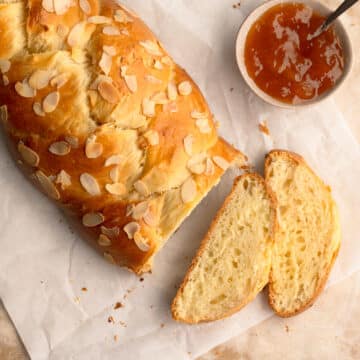
Sweet Sourdough Braid
Ingredients
active wheat sourdough starter
- 60 g active wheat sourdough starter, mother starter / seed starter
- 60 g water, lukewarm
- 60 g wheat flour, German Type 405 or 550; all-purpose flour works well for US bakers
For the braid dough
- 180 g active sourdough, from step 1
- 450 g wheat flour, German Type 405 or 550; all-purpose flour works well for US bakers
- 80 g sugar
- 200 ml milk, lukewarm
- 1 ½ medium eggs, reserve ½ egg for brushing
- 1 teaspoon salt, level
- 1 teaspoon vanilla paste, optional
- 95 g butter, soft
For brushing
- ½ medium egg, beaten
- 1 tablespoon milk
Instructions
- Refresh or feed the sourdough first. Stir the starter, water, and flour vigorously in a large jar. Set the lid on loosely and leave it in a warm place until the sourdough has roughly doubled in size and is full of bubbles. For me, this takes about 3 hours.
- For the dough, beat 1 egg and refrigerate about half of it for brushing later. Add the remaining 1 ½ eggs, all of the active sourdough, the flour, warm milk, sugar, salt, and vanilla paste to a large bowl. Knead with a stand mixer for about 3-5 minutes until a fairly even dough forms.
- Gradually knead in the soft butter in small pieces over about 5 minutes. The finished dough should be soft, elastic, and slightly glossy or silky.
- Cover the dough and let it rest at room temperature for about 2 hours, until it looks a little looser. Then cover well and refrigerate overnight.
- The next morning, take the dough out of the refrigerator and let it come to room temperature for about 1 hour. Divide it into 3 equal pieces on a lightly floured surface. Roll them into long strands and braid into one large loaf. Carefully transfer it diagonally onto a baking sheet lined with parchment paper.
- Cover the braid and let it rise at room temperature for 2-3 hours, until it has visibly puffed up.
- Preheat the oven to 350°F / 175°C conventional heat (top and bottom heat). Whisk together the reserved half egg and the milk. Brush the braid with it and sprinkle with sliced almonds if you like.
- Bake the braid for about 30-35 minutes until golden brown. If it browns too quickly, tent it loosely with foil toward the end. Let it cool completely before slicing.

Thank you very much for the recipe and the video. That is so helpful. The braid looks awesome! We only use our home-ground spelt or einkorn wheat flour. Would any of these or a combination work? I also bought some hulled barley berries and could use those.
Thank you so much for your kind comment – I’m really happy you enjoyed the recipe and the video!
I haven’t tested the recipe with spelt or einkorn myself, so I can’t say for sure how it will turn out. But in general, this is quite a delicate dough since it’s enriched and only leavened with sourdough – so the flour choice makes a big difference. My guess would be that whole grain flours (whether spelt or einkorn) might make the dough heavier and a bit more difficult to handle, and the braid may not rise as much or hold its shape as well.
If you’d like to experiment, a lighter (more refined) spelt flour would probably be the safest option. Einkorn or very coarse/whole grain flours can be trickier because of their weaker gluten structure.
Barley is also quite low in gluten, so I’d only use it in small amounts, if at all, in a recipe like this.
If you do try it, I’d love to hear how it turns out!